You decide. It grinds.
Zozo works your backlog while you sleep: grilling vague ideas into issues, pausing to ask when a decision is genuinely yours, and merging nothing without your approval. One dedicated machine, your own credentials, an append-only record of everything it did.
$40 / $50 / $60 per month before tax · 14-day money-back · no inference markup, ever · or $0 on your own machine
One night, end to end
You went to bed. It kept going.
Not a cron job that fires blind, and not an agent that guesses. A loop that runs unattended, hands back only the sliver that needed a human, and resumes the second you answer.
Why not just run it yourself
You stop being the session it runs on.
Inside a single task you don't need this. A terminal running Claude Code is plenty capable, and that was never the question. The question is attention. A terminal agent needs you sitting there: deciding what's next, re-entering context every time you come back, watching so you notice when it's stuck. You are the thread it runs on. You supply the continuity, the sequencing and the recovery, with your own presence, for as long as the work takes.
Zozo takes over being the thread. It keeps running when you're not looking. It unblocks the next issue the instant its blocker closes: continuously, not on whatever schedule you remember to check. And it hands back only the sliver that actually needed a human, in the smallest unit it can, at the moment it's needed: a push to your phone, one card on the Needs Attention page, your answer, and it resumes on its own. Judgment in seconds, not sessions.
The core loop
Idea → issues → code → pull request
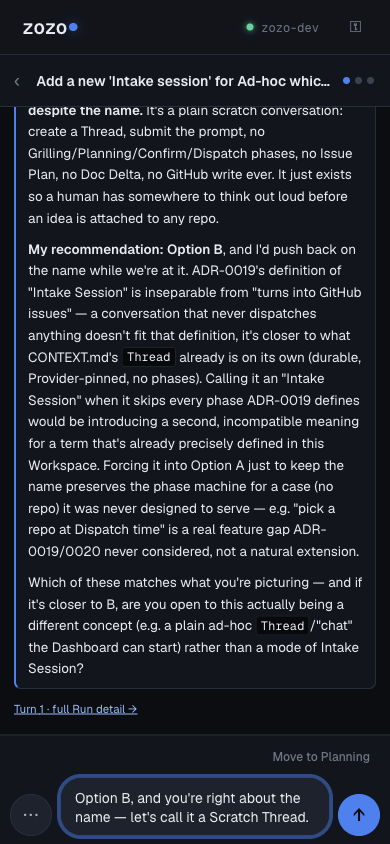
Two ways in. One path out. Bring a half-formed idea and let an Intake Session grill it into a plan, or label an issue ready-for-agent and skip straight to the dispatch. You're never forced through the grilling to get work done.
Clarification
It asks instead of guessing.
Sometimes an issue that looked ready is missing a load-bearing decision. If the answer isn't in the issue, the docs, or the codebase, the attempt stops and asks you on the same thread, keeping every file it has already touched in its worktree.
It waits. No timeout forces a decision before you're ready. Answer from your phone and the same attempt continues with your answer and all of its context intact.
Dispatch
The scheduling you'd otherwise do in your head.
Auto-dispatch is a standing mode, not a cron job. It parks when nothing can be selected and wakes the moment the picture may have changed.
The interval
Checks GitHub for anything newly selectable: an issue just labelled ready, or one whose last blocker was resolved.
A run concludes
Capacity re-arms selection immediately, so the next issue starts without waiting for a tick.
A PR lands
Revisits every project whose selection picture just changed, the instant it changes.
It respects your dependency graph
Work blocked on another issue waits. A reconciler rechecks every open issue on every watched project once a minute, and a pre-selection check closes the last timing gap, so an issue whose blocker resolved seconds ago can join the pick already under way. Most autonomous-agent tooling doesn't attempt this.
How blocking works →It knows when to stop itself
Three consecutive attempts failing for the same reason trip a circuit breaker and end the pass; selected-but-unstarted issues go back to ready. If GitHub can't be read for one project, that project is skipped and the rest of the fleet keeps moving. Suspend stops new selections and lets in-flight runs finish cleanly.
How dispatch decides →Why you can leave it running
Nothing needs you until morning.
Unattended is a promise about blast radius, not optimism. Here's what the boundary actually is.
Your Home Region stays fixed
Your Home Region is permanent for the life of your account. During maintenance, Zozo may move your Stack within this region, which can change its IP address. Signing up is standing consent to those moves: we'll notify you of an IP-changing move without asking for further confirmation.
Morning review is reading, not archaeology
Every turn, tool call, command, and decision is journaled as it happens, and the Dashboard renders runs from that same journal it uses to stream, resume, and recover. What ran while you were asleep is a record you read top to bottom, not a diff you reverse-engineer to work out what it was thinking.
Updates that can't strand you
Hosted releases roll out in health-gated waves. Your stack waits for active work to finish, takes a local backup, applies the update, verifies its health, and reverts automatically if the update fails. Host-infrastructure moves have to prove themselves healthy for minutes before any traffic switches over.
The compounding corpus
Month six asks better questions than month one.
Grilling needs something to check against. So Zozo writes the answers down, in your repository, as ordinary files.
Decided, not guessed
Every follow-up question depends on a real line between decided and undecided. The glossary or ADR update proposed on an issue is applied as the first act of the dispatch that picks it up, before any code, so the next clarification has one more fact to work from.
A byproduct of shipping
No separate step, no maintenance chore. It happens on every issue that lands. An undocumented repository gets grilled harder at first (there's nothing written down yet to check against) and gets easier every month you use it.
The record lives in your repo
Decisions land as CONTEXT.md and ADRs on your own remote, committed like everything else. Not a record we keep about you: text you grep in an editor and edit by hand when a decision changes.
Wayfinder · included
For an idea too big for one issue, it charts a map first.
Some ideas are bigger than a single issue can hold. Wayfinder charts one as a map: a graph of the open decisions standing between the idea and the destination. Each decision becomes a ticket, typed for how it actually gets resolved: answerable by reading, by your judgment call, by a disposable prototype, or by work that only unblocks the next decision.
Every ticket resolves on its own terms, and what's learned composes into a spec before a single line of implementation is ticketed. It ships on for every tenant, new and existing.
Pricing
You pay for the machine. Not a markup.
The fee pays for us operating your stack, not for owning your only way to run it: the Local Stack is free on your own machine. Connect the Claude or Codex subscription you already pay for and Zozo adds no inference charge on top of it.
The same Dashboard and loop on your own Mac or Linux. No account.
$ npx zozohq@latest up
A dedicated machine for one Run at a time.
Three runs at once is where a backlog starts visibly draining.
For a dozen repos and an API key behind them.
Subscription credential
your plan's own priceConnect the Claude or Codex subscription you already pay for and this line is your model spend. There's no dollars-per-month range to publish because there isn't one to have: what constrains you is your own plan's usage limit, and one run at a time paces you against it instead of racing it. That's a pace, not a guarantee. This is the recommended path when you're footing the bill, and it needs your explicit, recorded consent to run unattended.
API-key credential
as much as you let it runMetered by Claude or Codex on your own vendor account, with no markup from us, which is why it stays the default when a client is footing it and the spend needs to be a line item on their invoice. Dispatch the whole backlog unattended, or one issue on demand and nothing else. Every run reports its own tokens and cost into a daily per-provider rollup you can read: the figure your settings produced, measured on your account, not estimated from ours.
Monthly prices in USD before applicable tax · both credential paths supported on every plan · plan changes available once the subscription is active · the Local Stack is free and needs no account
FAQ
The questions a careful developer asks first
Stop being the thread it runs on.
Pick a Plan and pay from day one, with a 14-day money-back window. No invite code, your own credentials, nothing merged without you.
Product updates
Not ready for a hosted Stack? Run the free Local Stack with npx zozohq@latest up, or leave your email and we'll write when something ships.
Double opt-in: confirm by email. To be removed, contact support@zozohq.com.